Most packer-shippers already use barcodes. That’s not the issue. The issue is whether your system is controlling the work or documenting it after the fact.
FSMA 204 traceability records do not become inspection-ready when FDA calls. They become inspection-ready as data is captured in real time, as the activity is performed.
That distinction is critical for produce operations.
For many packer-shippers, traceability has historically been a combination of paper records, spreadsheets, and system updates performed after the fact. Those approaches can work for internal operations, but under FSMA 204, they create risk.
The new requirement is not just to maintain records. It is to produce complete, accurate, and sortable traceability data within 24 hours, tied to specific Traceability Lot Codes (TLCs) and supported by all required Critical Tracking Events (CTEs) and their Key Data Elements (KDEs).
Meeting that requirement consistently requires a different approach.
It requires Electronic Data Collection (EDC).
In the produce industry, barcode technology is the predominant tool used by packer-shippers to improve traceability accuracy and consistency.
But barcoding by itself does not create discipline, the addition of comprehensive Electronic Data Collection (EDC) does.
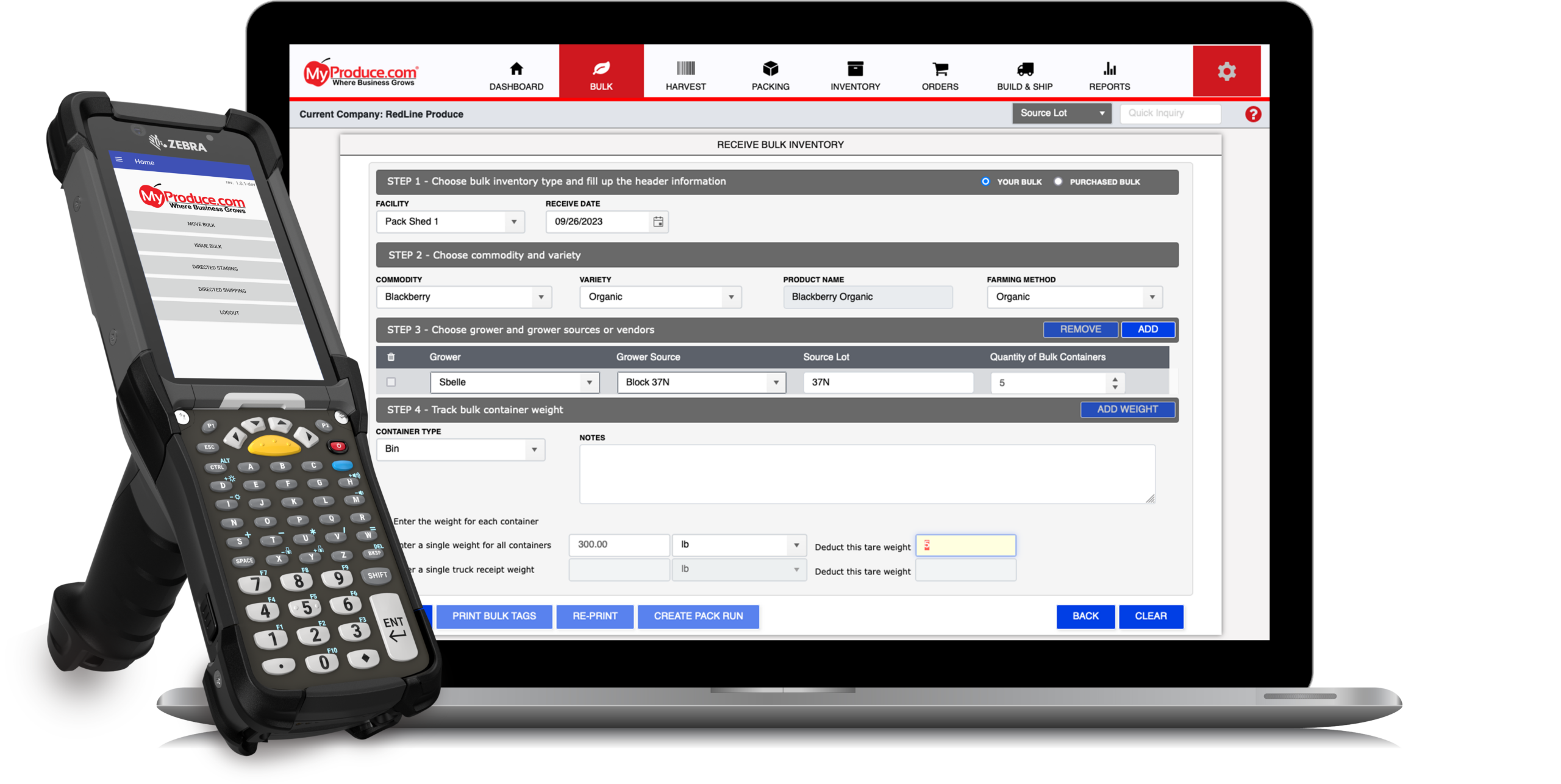
When barcode scanning is combined with forklift-mounted tablets or rugged mobile devices connected through Wi-Fi, the system becomes interactive.
It does not just record what happened. It guides what should happen.
That interaction changes how operational work is performed.
With EDC in place, worker actions are no longer independent of the system, they are directed by it.
A forklift operator scans a pallet. The system validates the product, lot, and location. If the wrong product or Traceability Lot Code is selected, the error is detected immediately. The issue is corrected before the pallet is moved or shipped.
Most operations do not fail because they lack data, they fail because they cannot trust it under pressure.
FSMA 204 requires that specific Critical Tracking Events (CTEs) be documented, each supported by defined Key Data Elements (KDEs).
In many operations, these data points are collected manually and later assembled into records.
EDC changes that model.
When data is captured in real time at each activity (receiving, cooling, packing, palletization, staging, and shipping) the required KDEs are recorded as the work is performed. Those data points naturally form the required CTEs.
Instead of reconstructing events after the fact, the system builds a continuous, accurate traceability record as product moves through the operation.
This is what makes a system truly inspection ready.
One of the most common causes of traceability breakdown is process drift.
•Pallets are modified without documentation
•Product is moved without being recorded
•Lot transitions are missed in real time
•Shipment verification becomes reconstruction
Electronic Data Collection addresses this by enforcing your workflow.
The system requires the correct sequence of actions:
•Grower Lots are validated before packing
•Harvest Locations are confirmed
•Case-level Traceability Lot Codes are captured at palletization
•TLCs are recorded as cases are added to or removed from pallets
•Pallets are matched to shipments before departure
Because the system is guiding the user, deviations are identified immediately.
This prevents small errors from becoming larger traceability gaps.
A common misconception is that traceability systems slow down operations.
In practice, well-designed EDC systems improve efficiency.
When workers are directed by the system:
• Pallet put-away locations are recorded automatically • Operators are directed to specific pallet locations during order fulfillment • Product selection is validated against order criteria • Manual corrections are reduced
Instead of searching for product or correcting errors later, workers are guided to the right product the first time.
This improves throughput while strengthening traceability integrity.
Shipment records depend on what was captured before the truck left.
The 24 hour requirement under FSMA 204 is often misunderstood as 24 hours to scramble and assemble records. In reality, it’s about whether those records already exist in a complete and usable form.
If your system relies on:
•Paper logs
•End-of-day data entry
•Spreadsheet reconciliation
•Manual verification
Then your traceability process depends on reconstruction.
If your system captures data in real time through EDC, your records are already aligned with the physical movement of product and are already defensible.
For more than 20 years, RedLine Solutions has helped packer-shippers implement Electronic Data Collection systems that align operational workflows with traceability requirements.
These systems have consistently improved inventory accuracy, shipment verification, and operational efficiency.
Today, those same capabilities enable packer-shippers to meet the data capture and recordkeeping requirements of FSMA 204.
Because the core principle remains the same: capture data as work happens. Validate it immediately. Use it to control the process.
FSMA 204 is often viewed as a compliance challenge.
In reality, it is a system design challenge.
Operations that treat traceability as a documentation requirement will struggle to meet the 24 hour expectation while operations that treat traceability as an operational control system will meet it naturally.
Electronic Data Collection is the bridge between those two approaches.
It connects physical product movement with digital traceability records in real time, turning traceability from something you document after the fact into something you control as it happens.
If your traceability system depends on manual, after-the-fact data entry, your inspection readiness is built on reconstruction.
If your system captures data as work happens, your records are already defensible.
The question is not whether you are capturing data. it is whether your system is controlling the process. Learn more about our solution for this at https://redlineforproduce.com/software/ .
For 27 years, RedLine Solutions has been the trusted partner in inventory and traceability for fresh produce stakeholders across North America. Serving a myriad of commodities, we tailor solutions to your workflow. Our offerings, from hardware to software, coupled with deep expertise, ensure your produce operations management is in the best hands.
