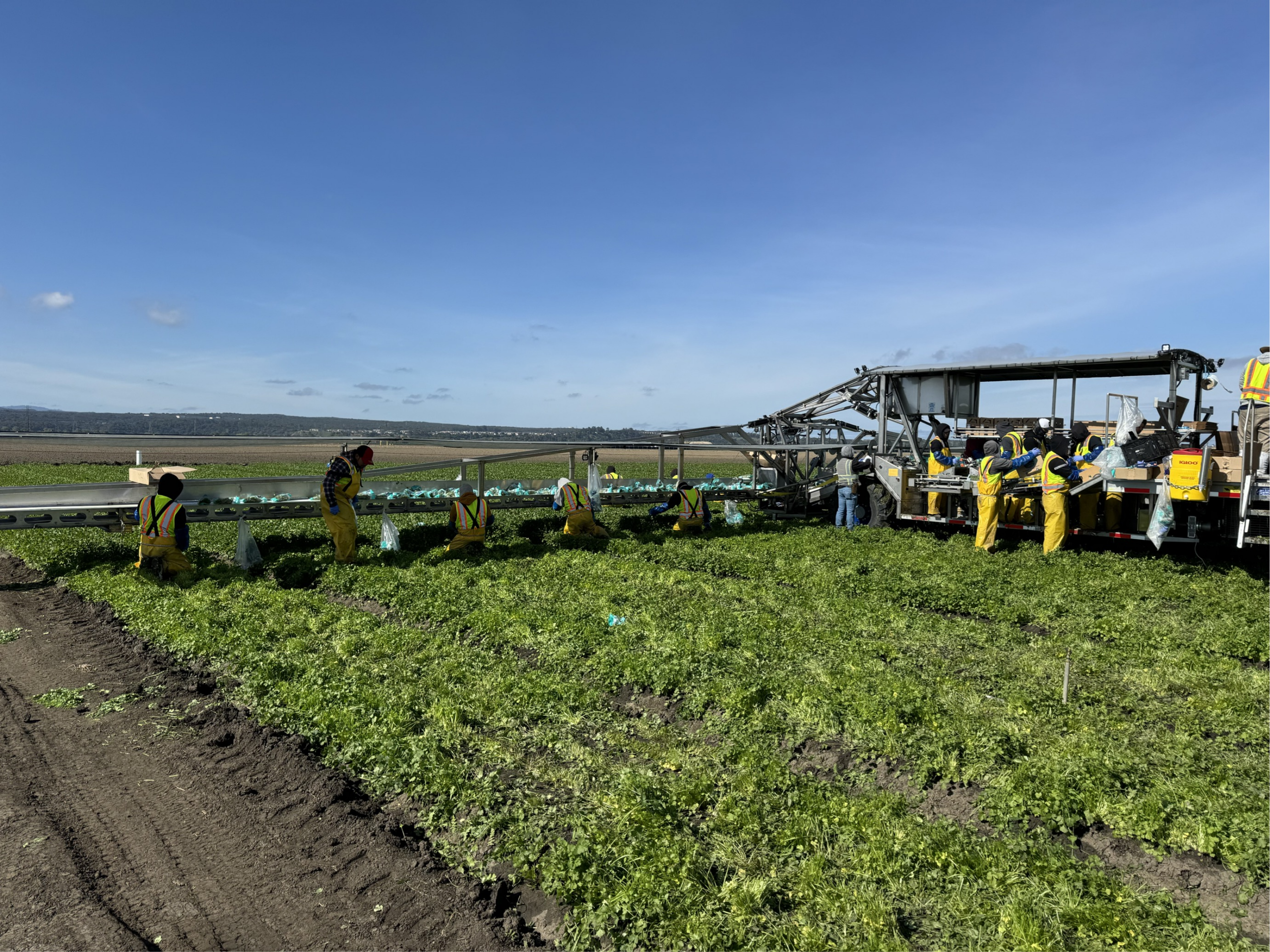
If you field-pack commodities like lettuce, broccoli, cauliflower, celery, or berries, your traceability risk profile is fundamentally different from shed-pack operations. You don’t have bulk storage as a buffer and you don’t have the opportunity to relabel products coming off a packing line.
In field-pack operations, the Traceability Lot Code (TLC) is created before harvest begins. In fact, most case labels have been printed before the harvest begins. That changes everything.
In most field-pack operations:
That means the TLC was assigned before the first case is packed. If that TLC was defined too broadly, your recall scope is built into the system from the start. If that TLC was defined incorrectly, relabeling is expensive and operationally disruptive.
There is no easy reset button for field-packed items.
Field-pack operations move lot integrity risk upstream, requiring precision planning up front and increased discipline in the field at a number of pressure points.
1. Harvest Location Definition Before Label Printing
Before labels are printed or deployed to the field, someone defines:
• The Harvest Location and connection to the grower lot
• The commodity and pack configuration
• The Traceability Lot Code
If Harvest Location is defined too broadly (for example, an entire ranch instead of a specific block), every case packed under that TLC inherits that broader scope. If this happens and an issue is isolated to a single block, your recall still covers all product using that TLC.
Precision lost at the planning stage cannot be recovered downstream. Field-pack traceability begins at the desk, not the knife.
2. TLC Transitions Between Blocks
Harvest crews move. Fields get subdivided. Blocks are completed mid day.
The critical question is:
How cleanly does your harvest operation transition from one TLC to another?
Consider this scenario: A crew finishes Block A and moves to Block B.
When label rolls from a previous harvest event remain in circulation, cases from different Harvest Locations can unintentionally be labeled under the wrong TLC. That is not going to be seen as a simple paperwork error by the FDA. It’s structural traceability failure.
Under FSMA 204, your records must clearly associate product to specific Harvest Locations. If physical labeling discipline is weak during block transitions, documentation becomes weak.
3. Label Control and Destruction Protocols
One of the most overlooked vulnerabilities in field-pack operations is leftover label control. Unused labels represent risk.
If rolls are not reconciled and destroyed after a harvest event, they open you up to vulnerabilities:
• Old TLCs can re-enter circulation
• Misapplied labels may go unnoticed
• Cases may leave the field with an incorrect TLC
Strong field-pack operations implement:
• End of day label reconciliation
• Supervisor sign off when transitioning blocks
• Physical segregation of old and new TLC labels
• Controlled storage of unused label stock
This may sound procedural, but in the absence of strict label discipline, recall scope expands through human error.
4. Pallet Integrity
In many field-pack models, pallets are built complete and shipped as constructed.
However, some commodities, such as berries, may involve pallet consolidation upon receipt at the distribution center prior to precooling for time and space efficiency.
When consolidation occurs, lot integrity must still be maintained.
If cases from separate TLCs are combined on a pallet:
• Are they recorded digitally in real-time during consolidation?
• Are the contents of that pallet ID instantly updated in your traceability system?
• Does the shipping documentation reflect the correct TLC’s and their respective quantities on each pallet?
If consolidation is performed physically but not captured digitally, traceability reporting becomes unreliable.
Under a 24 hour FDA request, data reconstruction becomes necessary which widens the scope of any investigation and potential recall.
When designed properly, field-pack operations can achieve exceptional traceability precision.
Why?
Because product moves in a more linear fashion:
Harvest
Pack
Palletize
Ship
There are fewer physical touchpoints and clear physical transitions between harvest locations.
But this advantage only exists if:
• Harvest Locations are precisely defined
• TLCs are designed narrowly enough to reflect realistic risk boundaries
• Label control is strict
• Transitions are digitally confirmed
• Pallets are verified by digitally capturing any changes made before shipment
Without discipline, you can create broad recall exposure quickly.
Under FSMA 204, at harvest you must maintain records including:
• Harvest Location boundaries and field name description
• Harvest date
• Commodity
• Quantity and unit of measure
• Traceability Lot Code
The critical questions become:
When and how is that data captured?
Is harvest location written on paper and entered later?
Or captured digitally in real time?
Is the TLC assigned before harvest based on planned blocks?
Or generated dynamically with confirmation?
Who verifies that the physical harvest matches the planned harvest locations?
Field-pack traceability is strongest when:
• Harvest supervisors are trained in TLC control
• Electronic data collection confirms harvest location
• Case labels are tied directly to validated Harvest Location data
• Shipment records reflect verified pallet contents
The closer to real-time your data collection, the more defensible your system becomes.
The Cost of Overly Broad link between TLC and Harvest Location
Some field-pack operations may define TLCs conservatively to simplify management.
For example:
“All product harvested on Ranch 12 today.”
That may feel operationally simple; but from a precision standpoint, it is expensive.
If contamination later traces to one zone within Ranch 12, your TLC may encompass multiple blocks, crews, and the entire day’s harvest from Ranch 12.
Well-defined TLCs reflect meaningful risk boundaries, the primary being the harvest location at the block or sub-block level. It also takes into account the harvest window, generally a single day. Most organizations will also maintain linkage to the crew that harvested the item.
Precision at TLC definition protects you later.
Field-pack operations rarely get a second chance to clean up lot integrity. Once product leaves the field with a printed case label, TLC correction is disruptive and costly.
The real question is not whether you can generate a report within 24 hours, but rather: Does your TLC design have enough precision before the first case was packed?
If you selected just one pallet harvested today and traced it back to its Harvest Location, could you do so confidently without the need to widen the scope to cover adjacent blocks “just to be safe”?
That confidence is not created during a recall. It is created during harvest planning.
For field-pack grower-shippers, lot discipline truly begins before the first cut.
For 27 years, RedLine Solutions has been the trusted partner in inventory and traceability for fresh produce stakeholders across North America. Serving a myriad of commodities, we tailor solutions to your workflow. Our offerings, from hardware to software, coupled with deep expertise, ensure your produce operations management is in the best hands.
